

TrainPoint Institute News
Public Speaking Training for School Students | Speak with Confidence, Lead with Impact
Build confidence, communication and leadership skills with public speaking training for school students. Explore practical training options for young learners.
TrainPoint Institute · September 17, 2026 · 3 min read
Tags: Public Speaking Training for School Students
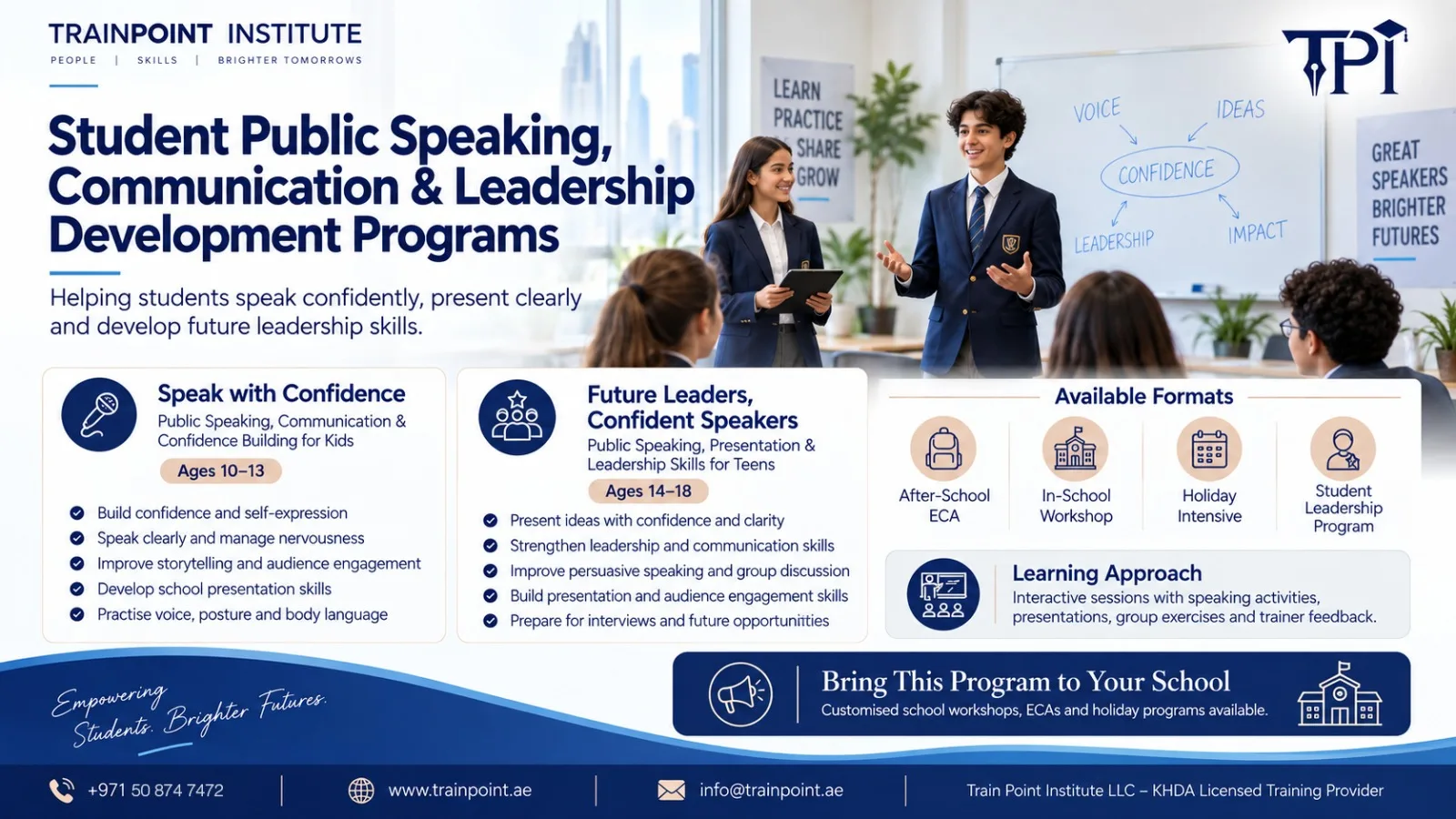
Public Speaking Training for School Students
When a student has skills and knowledge but is too nervous to share them, public speaking training for schoolchildren can make a real difference. At first, speaking in front of the class, presenting a project, joining a debate, or answering questions may feel uncomfortable. However, with proper practice, students can learn to organize their thoughts, speak clearly, control their nervousness, and connect with their audience.
Why is public speaking important for students?
Public speaking involves more than delivering speeches; it is a communication skill students can use at school, at university, and in their future careers. When school students receive public speaking training, they can practice various kinds of presentations, storytelling, group discussions, introductions, and spontaneous speaking in a supportive setting.
Consider a student who is preparing for a university interview. It is one thing to know the answer and quite another to explain it with confidence. Through regular speaking practice, students become more comfortable expressing their opinions and answering questions without relying entirely on memorized lines.
How does public speaking training develop students' ability to lead?
Leaders must communicate, so student leadership training and communication development go hand in hand. Students learn how to present an idea, lead a discussion, listen to different opinions, and speak respectfully when they disagree.
A high school student's course in practical public speaking and leadership may involve team activities, presentations, role-play, problem-solving exercises, and brief leadership challenges. This gives students the chance to put their leadership skills into practice rather than just read about them.
What Skills Do Students Learn?
Public speaking training for school students should include more than just writing speeches. Students can acquire abilities such as:
Organizing ideas into a clear structure
Using voice, pace, pauses, & tone
Improving eye contact and body language
Speaking without depending completely on notes
Handling audience questions
Building confidence during presentations
Listening and responding effectively
These abilities can help students participate in the classroom, attend school events, enter competitions, fill out university applications, and communicate in future workplaces.
How might students overcome their fear of speaking in public?
It is normal to feel afraid. The solution is not to tell students to "stop being nervous"; instead, give them enough practice so they feel prepared. School students can begin their public speaking training with short introductions before moving on to presentations, group speaking, and spontaneous questions.
A supportive classroom is also important; students should have room to make mistakes, get useful feedback, and try again. These small improvements will, in turn, make the next presentation feel less intimidating.
What is the advantage of taking public speaking training in Dubai?
If schools in Dubai want to offer students public speaking training, they might consider courses that build communication, teamwork, and leadership skills. Dubai's diverse learning environment means students often interact with classmates from diverse cultural and linguistic backgrounds. Learning to communicate clearly with a variety of audiences is therefore an asset.
FAQs
Q1. At what age can people receive public speaking training?
Students can start learning public speaking through age-appropriate activities early on. High school is especially useful for building the skills needed for presentations, interviews, debates, and leadership communication.
Q2. Can public speaking help to boost students' confidence?
Certainly, public speaking training gives students chances to speak, receive feedback, and improve. As a result, classroom presentations and group discussions become easier to manage.
Q3. What does a student leadership course cover?
The program can include communication exercises, presentations, teamwork, problem-solving, decision-making, leadership activities, and feedback; the specific content will vary by students' age and learning objectives.
Q4. Is it useful to speak in public at university?
Certainly, university students often give presentations, take part in seminars, work on group projects, and attend interviews. Building communication skills early can give them a stronger foundation for these situations.
Q5. What method can schools use to choose the appropriate training program?
Schools should focus more on practical sessions than on theory alone. Students should have the chance to speak, take part in activities, get feedback, and practice various communication situations. The program should also consider students' age, confidence level, and learning objectives.
← All articles · Contact the team
Related articles
-
 TrainPoint Institute News
Train The Trainer Certification Course: Develop the trainer's skills with confidence.
Develop practical training and facilitation skills with the Train The Trainer Certification Course in Dubai, designed for HR professionals, managers, team leaders and aspiring trainers.
-
 TrainPoint Institute News
5 HR Professionals Chose CIPD Progress This August. Is Your Career Next?
Five HR professionals chose CIPD Level 3 and Level 5 in August 2026. Discover how a CIPD qualification can support your professional growth and HR career progression.
-
 TrainPoint Institute News
Claude for Project Managers: How AI Can Improve Planning, Reporting and Project Delivery
Discover how Claude AI helps project managers draft reports, summarise meetings, plan tasks, manage risks and improve project delivery.